[ad_1]
Chennai , BangaloreReal estate absorption is slowing down in the IT services sector due to a combination of slowing turnover, adoption of hybrid work model and redeployment of talent to tier-2 satellite offices.
However, that shortfall is being taken up by the Global Competence Centers (GCCs) of multinationals and product firms – companies whose numbers are on the rise and which seem to be getting more particular about in-person collaboration. GCCs are offshore entities that provide support services such as IT, finance and analytics to their parent organizations.
data from property research firm Anarock Shows that the share of IT-ITeS (IT-enabled services) firms in total office space in seven major cities declined to around 24% in the first quarter of 2023 from 42% in 2019. Simultaneously, the share of GCC has increased.
“The GCC currently occupies over 200 million sq ft of commercial stock in India and 500 new multinationals are expected to enter India and set up capacity centres,” said Anuj Puri, President, Anarock.
Among IT services firms, Cognizant has been the most aggressive in its effort to cut down on fixed asset costs. At an investor conference, Cognizant CEO Ravi Kumar said they plan to reduce 80,000 seats in big cities, and a part of this is to redeploy to tier-II cities.
“The hypothesis is not everyone’s going to come back to physical work,” he said. Real estate major DLF in its earnings call last week said that Cognizant has left 30-35% space in Chennai (with DLF) in a few years.
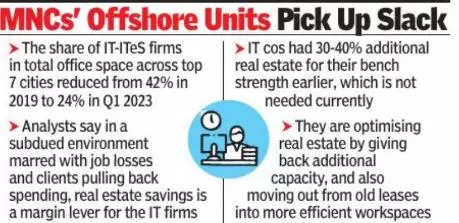
Analysts say realty savings are an important margin lever for IT companies in the current slowdown environment. Real estate accounts for 15-20% of the cost of IT majors. “Real estate is a large component of FTE costs and clients expect low or flat costs to make business attractive,” said Phil First, CEO of IT advisory HFS Research.
Ritesh Sachdev, SVP and Head of Commercial Leasing & Asset Management at Tata Realty & Infrastructure, said that IT firms earlier used to have 30-40% additional real estate for their bench strength, but today it is no longer required. Ritwik Bhattacharjee, chief investment officer at Embassy REIT, said Indian office demand today is led by global captives.
Anarock’s Puri also saw less dependence on traditional IT players. He added that the spirit of ‘China Plus’ has created opportunities for the manufacturing and industrial sectors and the share of real estate absorption by these two sectors has more than doubled.


[ad_2]
Source link