[ad_1]
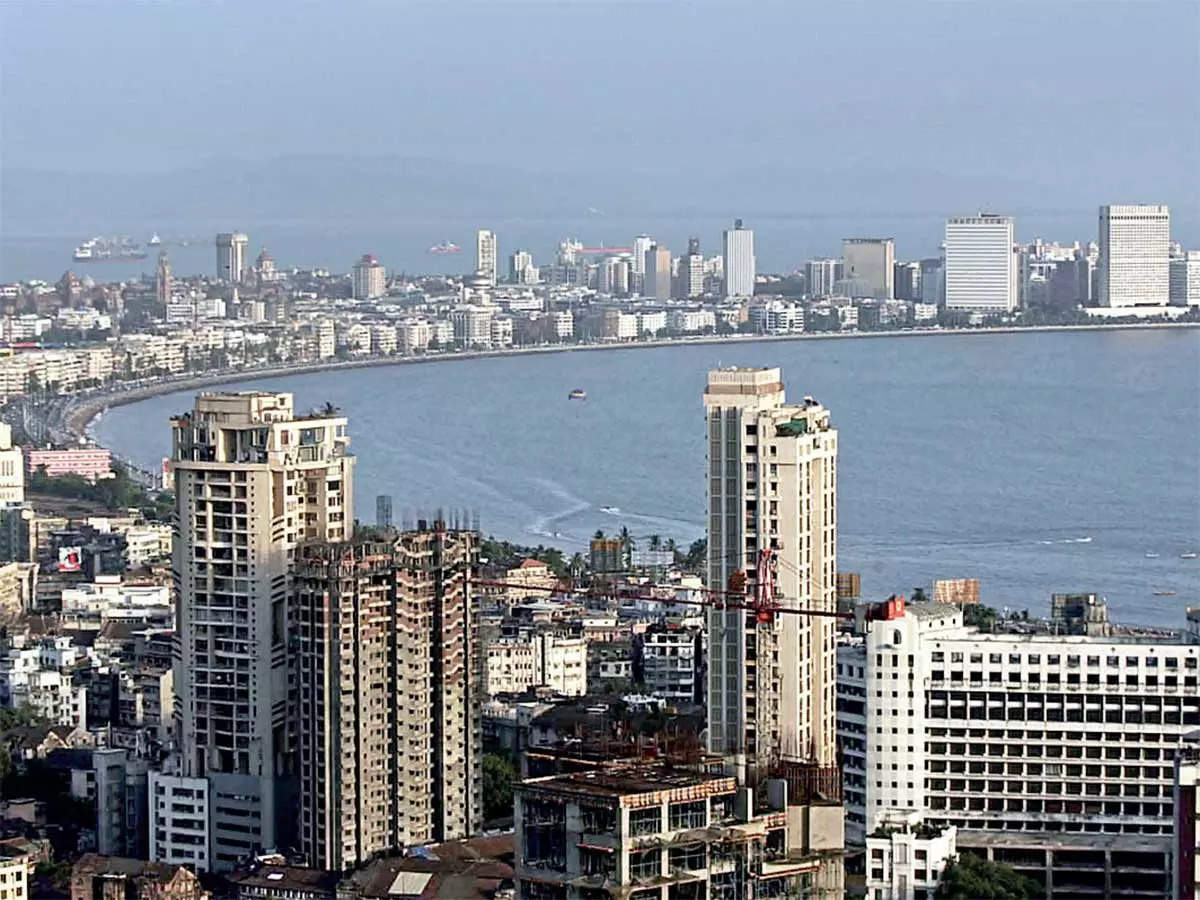
MumbaiIn a space-constrained city, Mumbai’s vertical growth is reaching stratospheric levels. virtually unlimited floor space index The (FSI) in some rehabilitation housing schemes has allowed developers to build higher and higher, even in congested areas.
Work has begun on India’s tallest residential twin towers on a two-acre plot of land that once housed the old Chikalwadi chawl, behind Bhatia Hospital in a narrow lane called Jawaji Dadaji Marg in south Mumbai.
The FSI, the ratio that defines how much can be built on a plot, is 10 under Development Control Regulation 33(9) for cluster redevelopment. The average FSI in the island city is around 3. An FSI of 10 means that on a plot of 1,000 sq m, a builder can construct 10,000 sq m.
The twin towers, named Aaradhya Avan, will be 312 meters tall and will have 18 podiums and 61 habitable floors when completed. Currently the tallest residential building in Mumbai is Minerva (306 m) at Mahalaxmi.
But can Mumbai afford such a huge construction given the high FSI available? Environmental sustainability planner and former chief planner of the Mumbai Metropolitan Region Development Authority Kedarnath Rao Ghorpade says Mumbai has been an “urban planning experiment laboratory” in terms of increasing land capacity.
Can mom carry vertical growth loads behind ‘unlimited’ FSI?
With some rehabilitation housing schemes allowing developers to build high-rise buildings with virtually unlimited floor space index (FSI), high-rise buildings are dominating the Mumbai skyline.
“The project would not have been possible without the higher FSI,” Manan Shah, MD of Man Infraconstruction, which is redeveloping the old Chikalwadi chawl in south Mumbai, told TOI. The chawl residents will be rehabilitated free of cost in a separate tower on a part of the plot. The total construction on a two-acre plot will be 13 lakh square feet.
“The means of increasing land capacity to meet the ever-increasing demand for additional floor space have been through development controls and promotion regulations. In addition, spatial variations in land use demand and consequent placement of different types of activities The reason is the increase in the capacity of the land FSI protein to absorb this demand,” said Kedarnath Rao Ghorpade, environmental sustainability planner and former chief planner of the Mumbai Metropolitan Region Development Authority.
But will the continued increase in FSI be sustainable without supporting infrastructure?
A leading developer in Mumbai said on condition of anonymity, “We see a lot of tinkering with building regulations on a regular basis and this needs to be stopped with a review process every 3-5 years. FSI needs to be added.” Road width as in the case of other project types. We can have higher FSI on the widest roads where rehabilitation requires such density but generally, there is no need to increase the FSI to such an extent. Also, the authorities need to strictly enforce parking and remove encroachments on all roads to make Mumbai a better place to work and live for all of us.”
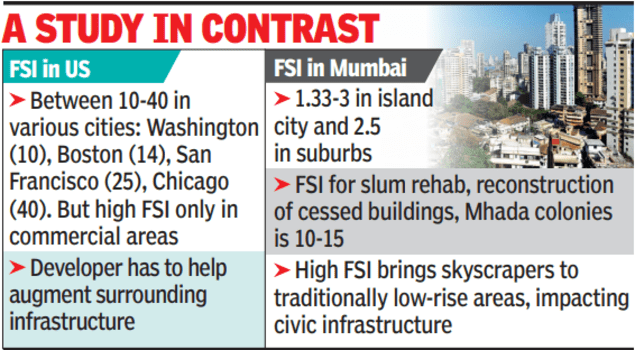
Housing expert Chandrasekhar Prabhu said the FSI could go up to 17 and even 20 for redevelopment of old and dilapidated properties in the island city. “Higher FSI requires taller buildings. Apart from misuse of building materials and increased construction and maintenance costs, concretization leads to unbelievable levels of density due to open spaces and poor planning,” Prabhu said. Claustrophobic conditions are created as a result, which has disastrous consequences for the well-being of citizens.”
But architect Manoj Desaria claimed that the BMC, before finalizing the new Development Control and Promotion Regulation (DCPR-2034), carried out a detailed study of civic infrastructure related to water, sewerage and storm water drains. “The conclusion came out that Mumbai can take the load of augmented infrastructure by various departments. Regarding the traffic issues, the government has already started mass transport system like metro, monorail, coastal roads, will ease traffic,” he said. Said.
Some real estate experts constantly cite the example of Manhattan and Hong Kong where, they say, the FSI is high to allow some of the tallest towers in the world. So, why not Mumbai?
But the building regulations in these cities are so strict that the open space for public facilities ranges from 85-90%. Significant impact assessments are carried out before plans are approved. New York-based architect Arzaan Sam Wadia said that higher FSI in US cities is allowed only in commercial areas. “Construction regulations in residential areas are quite strict, mostly due to citizens’ action,” he said.
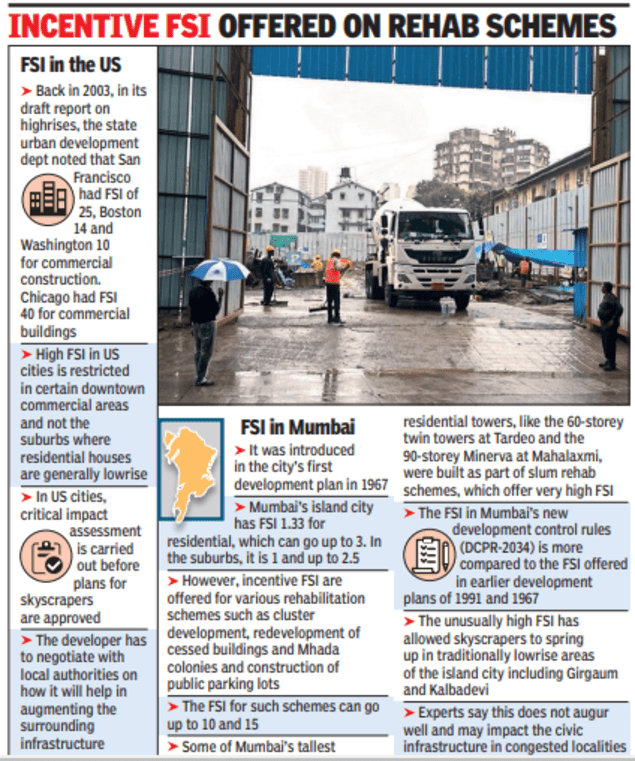
“Although rules and regulations exist, there is a (mostly) democratic process for requesting a higher FSI. The developer petitions agencies such as the City Planning Commission and local community boards for letters of support and submits the same to the city ,” he said. Wadia.
According to him, for the past several years, New York City mayors have also created guidelines that allow developers of high-rise buildings special dispensations on providing low-income housing, parks and public amenities. “In return, the developer may get tax exemption or the project may get tax exemption for a decade or two,” he said. “Public advocacy is strong and people come to these community board meetings and present strong cases if they don’t like what they see,” Wadia said.
A few decades ago, a developer wanting to set up an 80-story tower in New York’s Columbus Circus had to fight hard with the authorities to get his project approved. A high-rise building of this size, which could handle hundreds of people, would put a strain on the neighborhood’s infrastructure and the local body wanted the developer to address the issue. The developer was to fund the construction of a new metro station under the building to avoid overcrowding.
In Mumbai, experts said the lack of proper zoning laws and frequent amendments to the city’s development plan has resulted in rampant and haphazard development, especially in congested areas. Experts said zoning shapes the city and regulates building size, population density and land use patterns.



[ad_2]
Source link